

 4 min read
A wrong item in the box costs far more than the item itself. You pay to ship it twice, pay for the return, spend staff time on the ticket, and risk the customer never ordering again.
Most warehouses never put a number on that. This article does. We break down what a single mis-ship costs, show you how to calculate your own cost per error, and compare paper picking against barcode scanning so you can see where the payback lands.
What a mis-ship actually costs
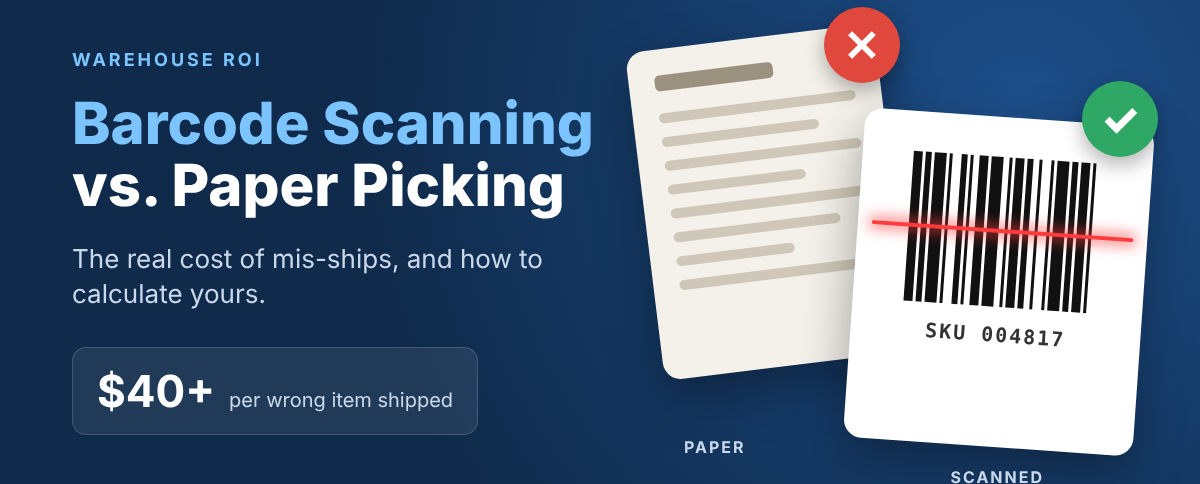
A single mis-ship typically costs $40 or more once every line item is counted. One fulfillment consultancy traced a client’s errors and landed at $43.23 per error, with two outbound shipments as the largest piece.
Here is where the money goes:
| Cost item | What it covers |
|---|---|
| Replacement shipment | Sending the correct item, often expedited to save the relationship |
| Return shipping | The prepaid label or call tag to get the wrong item back |
| Product loss | Items the customer keeps, or returns that can’t be resold |
| Support time | Reading the ticket, replying, issuing the label, following up |
| Rework labor | Re-picking, re-packing, and restocking the returned item |
| Lost customer value | Customers who never order again after a bad experience |
| Marketplace penalties | Order defect rate hits and seller rating damage on Amazon or Walmart |
The last two never show up on an invoice, which is exactly why they get ignored.
How to calculate your cost per error
Add up the per-incident costs, then multiply by how often errors happen.
Cost per mis-ship = Reship + Return + Product loss + Support + Rework + Churn
Monthly error cost = Orders per month × Error rate × Cost per mis-ship
Worked example
Take a store shipping 5,000 orders a month with an average product cost of $20. These inputs are illustrative; swap in your own.
| Cost item | Assumption | Cost |
|---|---|---|
| Replacement shipment | Ground label | $9.00 |
| Return shipping | Prepaid return label | $8.00 |
| Product loss | 25% of customers keep the wrong item × $20 | $5.00 |
| Support time | 15 minutes at $22/hour | $5.50 |
| Rework labor | 10 minutes at $20/hour | $3.33 |
| Lost customer value | 1 in 10 customers lost × $100 future profit | $10.00 |
| Total per mis-ship | $40.83 |
At a 1% error rate, that store makes 50 mis-ships a month. 50 × $40.83 = $2,042 a month, or about $24,500 a year, spent shipping the wrong thing.
Paper picking vs. barcode scanning
Paper picking relies on a person reading a SKU and matching it by eye. Manual picking without barcode verification typically runs a 1% to 3% mispick rate, while scan-verified picking often stays below 0.5%.
| Paper picking | Barcode scanning | |
|---|---|---|
| Typical error rate | 1% to 3% | Under 0.5% |
| When errors are caught | When the customer opens the box | At the shelf or pack station, before the label prints |
| Look-alike SKUs (sizes, colors, variants) | Common source of errors | Wrong scan is rejected |
| Quantity mistakes | Easy to miss | Each unit is counted by scan |
| New hire training | Must learn the products and locations | Scanner confirms every pick |
| Inventory accuracy | Drifts as mis-picks go unrecorded | Stays in sync with what actually left the shelf |
| Audit trail | Paper slips, if kept | Who picked what, and when |
The key difference is timing. Paper finds errors after they ship. Scanning stops them before they leave the building.
The ROI: where scanning pays for itself
Cutting errors from 1% to 0.2% saves the example store about $19,600 a year. The savings grow quickly if your current error rate is higher.
Same store: 5,000 orders a month, $40.83 per mis-ship, scanning at 0.2%.
| Current paper error rate | Mis-ships avoided per month | Monthly savings | Annual savings |
|---|---|---|---|
| 1% | 40 | $1,633 | $19,598 |
| 2% | 90 | $3,675 | $44,096 |
| 3% | 140 | $5,716 | $68,594 |
To find your break-even point, divide your setup cost (scanners plus software) by your monthly savings. For most growing stores, that is measured in weeks, not years.
Those numbers leave out two more gains: faster picks once staff stop double-checking paper, and inventory counts you can trust because every unit is scanned out.
How SKULabs stops mis-ships before they ship
SKULabs puts a barcode scan between every item and the box.
- Scan to pick. Pickers scan each item at the shelf. A wrong SKU or wrong variant is flagged on the spot.
- Scan to pack. Packers scan every unit against the order. The order can’t be completed until the contents match.
- Quantity checks. Each unit counts toward the order, so shorts and overs are caught before the label prints.
- Inventory stays accurate. Every scan updates stock, so what your channels show matches what is on the shelf.
The result: the customer opens the box and finds exactly what they ordered.
The bottom line
Paper picking feels free, but a 1% error rate on 5,000 orders a month quietly costs around $24,500 a year. Run your own numbers through the formula above. If the total surprises you, it is time to switch to scanning.
Want to see scan-verified picking on your own orders? Book a SKULabs demo and we’ll walk through it with your products.


