

 6 min read
Amazon 2027 FBA Fees: What’s Changing and When
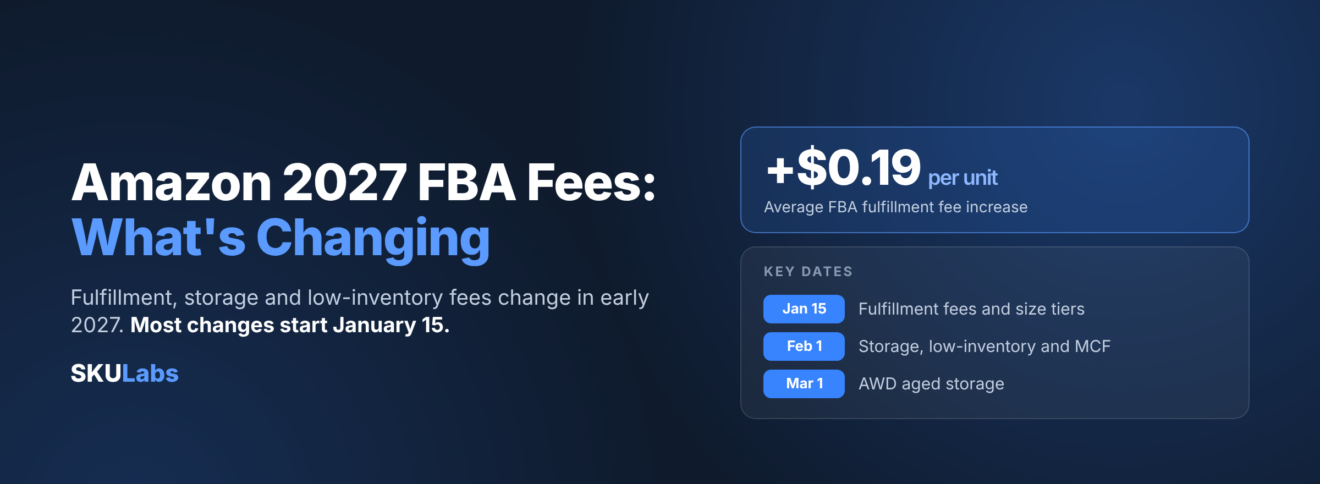
On November 5, 2026, Amazon announced its 2027 US referral and Fulfillment by Amazon (FBA) fee changes. FBA fulfillment fees rise by an average of $0.19 per unit, about 0.8% of the average selling price, starting January 15, 2027. Storage, low-inventory and Multi-Channel Fulfillment changes follow on February 1, 2027.
The $0.19 is an average. Depending on a product’s price, size and category, the actual change ranges from a few cents to a much larger share of the fulfillment fee, and some items get cheaper. This guide covers what is changing, when, and what to review in your catalog.
Key Dates
| Date | What changes |
|---|---|
| January 14, 2027 | Holiday peak fulfillment fees end |
| January 15, 2027 | New FBA fulfillment fees, new bulky and oversize size tiers, new handling fees, overmax handling fee removed, Low-Price FBA removed for five categories |
| February 1, 2027 | Unified monthly storage fee, revised low-inventory-level fee, Multi-Channel Fulfillment and Buy with Prime increases, AWD and Multi-Channel Distribution changes, monthly billing for promotions |
| March 1, 2027 | AWD inventory stored more than 12 months is charged 2.5 times the standard storage rate |
FBA Fulfillment Fee Changes
Fulfillment fees now vary more by selling price. Products priced above $50 see the largest increases.
Standard-size products: average increase per unit
| Size tier | Under $10 | $10 to $50 | Over $50 |
|---|---|---|---|
| Small standard | +$0.20 | +$0.40 | +$0.70 |
| Large standard (non-apparel) | No change | +$0.12 | +$0.47 |
| Large standard (apparel) | +$0.08 | +$0.12 | +$0.47 |
Here is how that adds up at volume: a small standard-size product priced above $50 that sells 2,000 units a month would pay about $1,400 more per month, or $16,800 per year.
The 3.5% fuel and logistics surcharge stays at 3.5%. Starting in 2027, it also applies to PanAmericas (January 15) and to AWD transportation and Multi-Channel Distribution (February 1).
Low-Price FBA removed for five categories
Starting January 15, 2027, products under $10 in these categories lose Low-Price FBA rates and pay the standard $10 to $50 rates instead:
- Automotive and Powersports
- Compact Appliances
- Computers
- Media (books, DVDs, music, software, video)
- Musical Instruments and AV Production
For example, the fee for a small standard-size DVD weighing 2 to 4 oz goes from $2.49 to $3.78, an increase of about 52%. Low-Price FBA continues for other eligible categories.
Bulky and Oversize Changes
Amazon is expanding its size tiers from 8 to 12:
- Bulky: two tiers become four (small, medium, large and extra-large bulky).
- Oversize: four tiers based on weight become six tiers based on dimensions (small, medium, large and long oversize, plus special oversize light and heavy).
Results vary by product. Some items get cheaper, such as a 65-inch TV that moves from $48.57 to $36.55. Long or flat items can cost much more, such as a 97-inch bulletin board that moves from $50.93 to $69.75.
Handling fee changes
- Overmax handling fee: removed.
- New flat product handling fee: $8.40 to $29.53 per unit, for items whose shortest side is under 4 inches and median side is 25 inches or more.
- New overhang handling fee: $3.45 to $10.45 per unit, for items whose median side is over 43 inches.
Storage Fee Changes (February 1, 2027)
- The monthly storage fee and the aged inventory surcharge are combined into a single unified monthly storage fee. Rates are based on size tier and how long inventory has been stored, and are assessed per FNSKU (Amazon’s fulfillment SKU).
- The storage utilization surcharge is removed.
- Amazon says inventory that sells within six months will see flat or lower storage fees, while older inventory will cost more.
- Clothing, shoes, bags, jewelry and watches lose their exemption from aged inventory fees for units stored 181 to 270 days.
Low-Inventory-Level Fee Changes (February 1, 2027)
The low-inventory-level fee applies when you keep too little stock at Amazon relative to sales. The revised version works like this:
- It applies only when days of supply is below 28 days in both the four weeks before and the four weeks after the assessment date. This replaces the previous 30-day and 90-day trailing measures.
- It now covers all oversize products.
- It appears as its own line item in Payments reports.
- Fees range from about $0.32 to $3.50 per unit, depending on size tier and how far supply falls below 28 days.
Exemptions include:
- New Professional sellers in their first 365 days
- New-to-FBA products enrolled in New Selection
- Products that shipped fewer than 20 units in the past seven days
- Grocery
- SKUs that are mostly auto-replenished through AWD
With the storage changes, this means sellers pay more both for stock that sits too long and for running too low.
Multi-Channel Fulfillment and Other Programs
- Multi-Channel Fulfillment (MCF) and Buy with Prime: standard-speed fees rise about 3.5% on average. Expedited standard-size rates are unchanged.
- MCF returns: returns that are not label-free or box-free carry a surcharge of $2.00 per standard-size unit or $2.50 per bulky or oversize unit, starting February 1.
- AWD: processing is $1.55 per box and transportation is $1.58 per cubic foot.
- Multi-Channel Distribution: palletized loads rise 8% and box loads rise 1.5%.
- Inbound placement: rates are unchanged. Central inbound locations for standard-size items consolidate into the East region.
- Buy X, Get Y promotions: a $5 upfront fee plus 2% of promotional sales, capped at $2,000 per promotion. All promotions move to monthly billing in February 2027.
- Remote Fulfillment: shipping from the US to Canada rises an average of $0.58 per unit, and to Mexico and Brazil $0.16 per unit each.
Referral Fee Changes
- 3D printers: 12% on the first $200 and 5% on the portion above $200, effective November 5, 2026.
- Amazon Renewed: a promotional 10% referral rate applies to eligible products through October 2027.
How to Review Your Catalog
- List your top FBA SKUs by units sold.
- Find each SKU’s size tier and price band under the 2027 tiers, especially items priced over $50 and items in bulky or oversize tiers.
- Calculate the impact: 2027 fee minus 2026 fee, multiplied by the units you expect to sell.
- Check the five categories that lose Low-Price FBA.
- Check dimensions of long or flat items against the new handling fees.
- Review inventory age before February 1 to limit fees on aged stock.
- Review days of supply to stay above the 28-day low-inventory threshold.
- Compare fulfillment options (FBA, fulfilling orders yourself (FBM) or a mix) using your updated per-unit costs.
Where SKULabs Fits
SKULabs connects with Amazon and your other sales channels to manage inventory and orders in one system.
- One inventory view: see FBA inventory, 3PL inventory and warehouse inventory in one place.
- Inventory sync: inventory changes sync to all of your sales channels.
- Orders in one system: orders from all of your sales channels are managed in one place.
- Amazon Shipping labels: buy Amazon Shipping labels for your Amazon orders in SKULabs.
- Direct carrier connections: labels are purchased through carrier accounts you connect to SKULabs.
- No label generation fees: SKULabs does not charge a fee to generate shipping labels.
Key Takeaways
- FBA fulfillment fees rise an average of $0.19 per unit starting January 15, 2027.
- Products priced over $50 see the largest increases.
- Five categories lose Low-Price FBA rates.
- Bulky and oversize tiers are restructured, and new flat and overhang handling fees replace the overmax fee.
- A unified storage fee starts February 1, and inventory older than six months costs more.
- The low-inventory-level fee applies when supply is under 28 days before and after the assessment date.
- Standard-speed Multi-Channel Fulfillment rises about 3.5%.


